
In short — Manuel Antonio is Costa Rica's smallest national park (1,983 hectares) and its most visited: postcard beaches backed by a forest where you can spot sloths, capuchins and squirrel monkeys in one morning. Count about US$18 for adult entrance, tickets to book online in advance on the SINAC website, and opening hours from 7am to 4pm, except Tuesdays. Two nights on site are enough for the park, a beach and a boat trip.
When a client asks me for « a park where you really see animals without walking six hours », I almost always answer Manuel Antonio. That's the paradox of this small strip of forest on the central Pacific: it fits in 1,983 hectares, you can cover it in half a day, and yet you observe more wildlife than anywhere else. In fifteen years, I've never accompanied a traveler who came out without having seen a sloth.
The flip side is the crowds. Manuel Antonio is the most visited park in the country, and it's also the one where it's easiest to ruin your visit: coming on a Tuesday (closed), arriving at noon (the monkeys are sleeping), or showing up without a ticket. This guide is here to avoid those three mistakes, and to tell you honestly what the region is worth beyond the park.
Manuel Antonio in three lines: where, what, how long
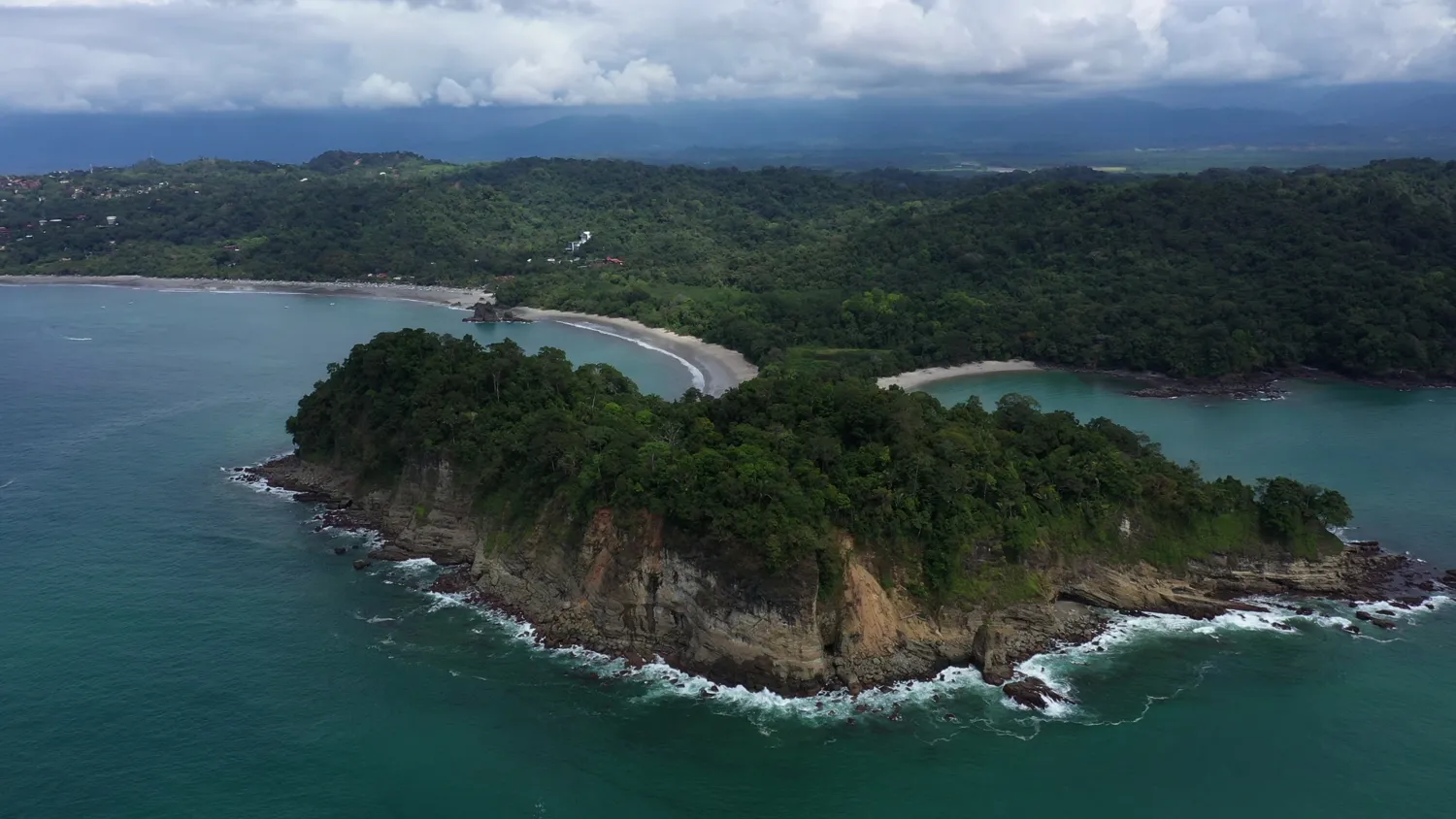
The park is on the central Pacific coast, just south of the port of Quepos, about 157 km from San José — count 3h to 3h30 by road, no less, as the end of the journey is winding. Created in 1972, it protects 1,983 hectares of land and nearly 55,000 hectares of marine area.
Time-wise: two nights on site is the right format. A morning in the park, an afternoon at the beach, a day for a boat or mangrove outing. Three nights if you travel with young children or if you really want to unwind; a single night is possible in a tight itinerary, but you'll leave frustrated.
The national park: tickets, hours and the Tuesday trap
Booking online is no longer optional
Tickets are purchased exclusively online, on the official SINAC platform (sinac.go.cr). There is no ticket office where you can try your luck the same morning. You choose a date and an entry slot, and the number of daily visitors is capped to protect the site.
In high season (December to April), slots sell out several weeks in advance. My advice: lock in the date as soon as your itinerary is set, even if you adjust the rest around it. That's exactly the kind of detail we handle for you when building a tour.
Hours, fees and closing day
| Practical info | Detail (2026) |
|---|---|
| Foreign adult entrance | about US$18 (tax included) |
| Child 2-12 years | about US$5 — free under 2 |
| Opening hours | 7am – 4pm |
| Closing day | Tuesday |
| Reservation | mandatory, online (SINAC) |
| Naturalist guide (optional) | from about US$65/pers. depending on the formula |
The Tuesday closure is the number one cause of wasted days in Manuel Antonio. Note it now, before booking your hotels.
Should you take a guide?
Honestly: yes, at least for this visit. It's not a question of trails — they are marked and easy — but of eyesight. A three-toed sloth motionless fifteen meters up is invisible to an untrained eye. Guides work with a spotting scope and share animal positions with each other; in two hours you'll see three times more.
The good compromise, if the budget is tight: do the guided visit in the morning (2 to 3 hours), then stay in the park on your own afterwards for the beach and the trails. Your ticket remains valid for the day.
Which animals do you actually see?
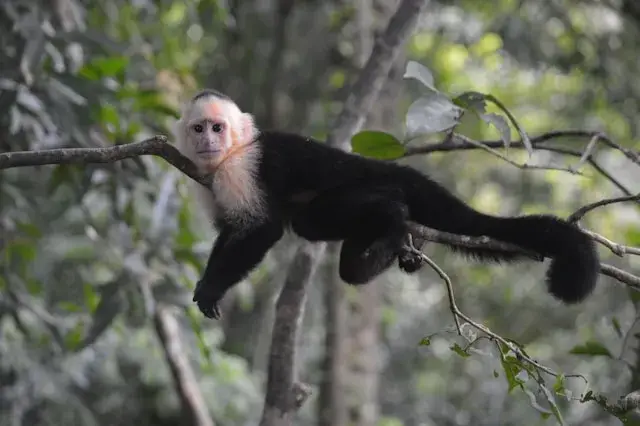
Manuel Antonio is one of the few places in the country where you can encounter four monkey species. The most visible:
- The squirrel monkey (mono tití) — the local star. The central Pacific subspecies is endangered and lives only on this stretch of coast. Small and russet, they move in noisy troops in the late afternoon.
- The white-faced capuchin — the cheekiest. It rummages through bags on the beach: keep yours closed and never feed it.
- The howler monkey — you hear it long before you see it, often at daybreak.
- Sloths, two- and three-toed, almost guaranteed with a guide.
- And the rest: iguanas, coatis, raccoons, agoutis, red crabs, toucans and a long list of birds.
If wildlife watching is your main driver, also read our dedicated guide to wildlife watching in Costa Rica — Manuel Antonio is only one piece of the puzzle.
The beaches: which ones are worth it
Manuel Antonio Beach, inside the park, is the most beautiful: an enclosed bay, light sand, calm water where you can really swim. It's also the busiest in the middle of the day.
Playa Espadilla Sur, also in the park, is longer and quieter, separated from the previous one by the tombolo that connects Punta Catedral — a former island — to the mainland. The trail that goes around it offers the park's most photogenic viewpoints.
North Espadilla Beach, outside the park, is the village beach: lively, with chair and board rentals, good for a surf initiation. Beware of rip currents, swim near the lifeguard posts.
Manuel Antonio logically appears in our selection of the most beautiful beaches in Costa Rica, but this is not the region to come looking for miles of deserted sand — for that, look instead towards Guanacaste or the Nicoya Peninsula.
What else to do around Quepos
| Activity | Duration | Indicative 2026 price |
|---|---|---|
| Catamaran / sunset with snorkeling | half-day | US$75 – 95 |
| Kayaking in the Damas Island mangrove | half-day | US$65 – 85 |
| Rafting on the Savegre river (class II-III) | full day | US$85 – 95 |
| Guided visit of the national park | 2 – 3 h | from US$65 |
The Damas mangrove is the outing I recommend most after the park: by kayak or small boat, early in the morning, you see crocodiles, ibises, squirrel monkeys and fishing bats, in a silence the park no longer offers. The rafting on the Savegre is an excellent family choice: real whitewater, but without technical commitment.
Quepos, finally, deserves better than its reputation as a mere transit port: the Pez Vela marina has grown a few good restaurants, and that's where you'll find everyday shops.
When to go, and what time to enter
The dry season runs from December to April : clear skies, calm sea, but maximum crowds and expensive accommodation. May-June and November are my favorite windows — late-afternoon showers, green forest, gentler prices. September-October remains the rainiest period on this coast: doable, but plan for flexibility.
As for the entry time, there's no debate: be there at opening, at 7am. The animals are active, the heat is bearable, and you'll have the trails almost to yourself for an hour. By 11am, the forest falls asleep and the paths fill up. The month-by-month climate detail is in our guide When to go to Costa Rica.
How to get there and where to sleep
From San José, the simplest route takes the coastal highway 34: about 3h by car. From The Fortune count 4h30 to 5h, from Monteverde about 4h. The car rental remains the most flexible formula — count €70 per day, basic insurance included. Shared shuttles also serve Quepos from the main stops, and a domestic San José-Quepos flight takes about thirty minutes.
On the accommodation side, two logics compete. The road between Quepos and the park concentrates the hillside lodges with ocean views: that's where the magic of the place happens, but you need a car or the local bus. The lower coast, near Playa Espadilla, puts everything within walking distance for a more measured budget. Our price ranges by category are detailed in the budget for a Costa Rica trip.
Manuel Antonio fits naturally into a 15-day itinerary, at the end of a tour, after the volcanoes and the cloud forest. You can also build and book your stay directly on Toucan Dynamics, our booking platform, assembling hotels, transfers and excursions yourself.
With children: what you need to know
Manuel Antonio is probably the most family-friendly park in the country: short flat trails, permanent shade, wildlife visible without effort, and a beach at the end. Two caveats however: the heat is heavy between 11am and 3pm, and the capuchins literally steal food from bags — warn the children beforehand, it avoids tears. Our complete tips are in Costa Rica with children and, for the little ones, Costa Rica with a baby.
Frequently Asked Questions
Is Manuel Antonio National Park closed one day a week?
Yes, it is closed on Tuesday. The rest of the week, it opens from 7am to 4pm. Always check Costa Rican public holidays on the SINAC website before locking in your date.
How much does entrance to Manuel Antonio cost?
Environment US$18 per foreign adult, tax included, and about US$5 for children aged 2 to 12. Tickets can only be purchased online, in advance, on the official SINAC platform.
How many days should you plan for Manuel Antonio?
Two nights are the right balance: a morning in the park, an afternoon at the beach, a day for the mangrove or a boat trip. Three nights if you travel with young children.
Are sloths a sure thing?
No sighting is ever guaranteed, but Manuel Antonio is one of the most reliable places in Costa Rica for it — especially entering at opening time and with a naturalist guide equipped with a spotting scope.
Want to include Manuel Antonio in your trip?
We are an incoming agency based in Costa Rica: we book the park tickets, set the schedules and build the itinerary around it. Reply within 24 hours to your quote request.
Request a personalized quote · Build your trip directly on Toucan Dynamics
Plan your trip to Central America.
A Toucan Discovery advisor helps you transform these ideas into a tailor-made itinerary — Costa Rica, Panama, Nicaragua. Real-time availability, instant quote.
Plan my trip French
 English
 Spanish
 Italian
 German
 Chinese