
In short. Costa Rica is one of the few countries in the world to receive two humpback whale migrations per year : those from the southern hemisphere from July to November (the most abundant, peaking in August-September), those from the northern hemisphere from December to April. The best place to observe them remains Marino Ballena National Park, in Uvita, on the southern Pacific coast, where a boat tour costs from about US$80.
Seeing whales in Costa Ricais not a stroke of luck reserved for the fortunate: it's a season, a place and a time. After fifteen years sending travelers to the southern Pacific coast, I can tell you the question is not « will I see any? » but « am I coming at the right time, and am I leaving with the right boat? ». The country has a particularity few destinations share: humpback whales come here twice a year, from two different hemispheres. The result: an observation window covering nearly nine months out of twelve.
Here's what you need to know so you don't get the month, the coast or the operator wrong.
Why Costa Rica has the longest whale season in the world
Geography does everything. Costa Rica sits almost halfway between the cold feeding grounds of the two hemispheres. Its warm, shallow waters, between 25 and 29°C, are an ideal calving ground: whale calves are born without insulating blubber and would not survive in polar waters.
Two distinct populations thus succeed one another:
- Southern hemisphere whales swim up from Antarctica and southern Chile. They arrive in July and stay until mid-November. This is the largest group, and by far the best for observation.
- Northern hemisphere whales come down from the coasts of California and Alaska. They are present mainly from December to March, with possible sightings until April.
In between, May and June are the quietest months. If whales are your main motivation, avoid this window — that's actually when I redirect travelers to other regions, such as Arenal volcano or the cloud forest of Monteverde.
When to go whale watching in Costa Rica? The month-by-month calendar
| Period | Population | Observation quality |
|---|---|---|
| July | Southern hemisphere (arrival) | Good, on the rise |
| August – September | Southern hemisphere | Excellent — the peak |
| October – mid-November | Southern hemisphere (departure) | Very good |
| December – March | Northern hemisphere | Good, fewer individuals |
| April | Northern hemisphere (end) | Hit or miss |
| May – June | None | Very low |
My field advice: September. It's the heart of the peak, the calves are a few weeks old and play at the surface, and the green season drives accommodation prices down. It rains, yes — but mostly in the late afternoon, and boat tours leave in the morning. It's the same reasoning I detail in our article on green season travel.
Where to watch whales: the four best spots
1. Marino Ballena and Uvita — the number one spot
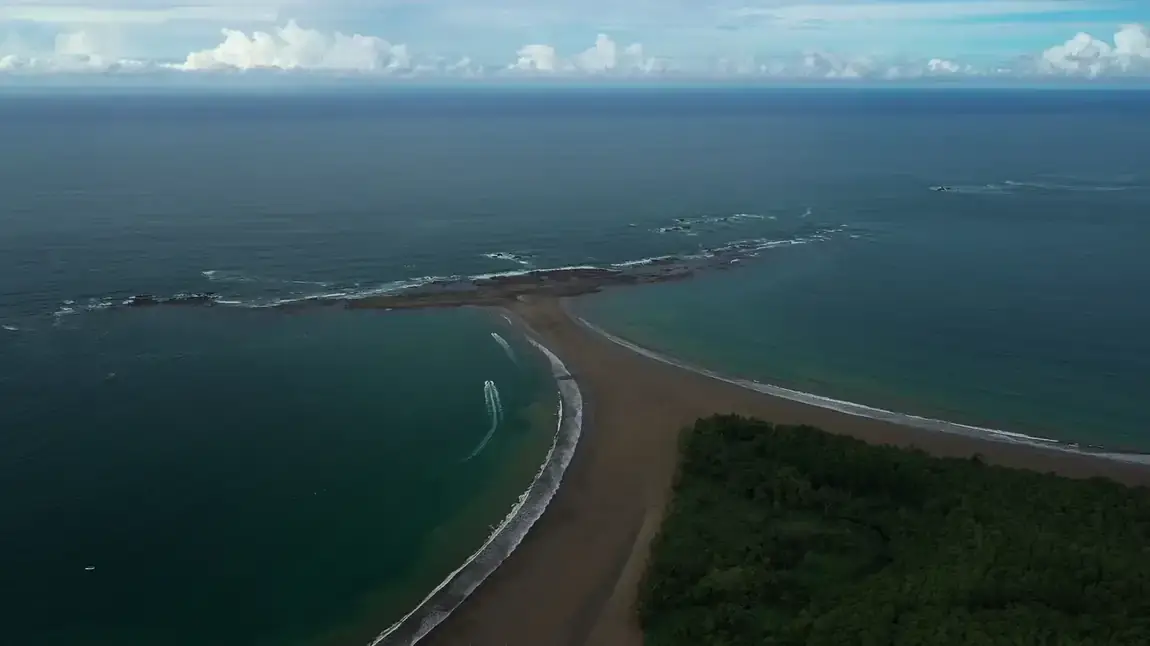
Created in 1989, Marino Ballena was Costa Rica's and Central America's first marine national park, and the country's first protected area created exclusively for its marine resources. It covers about 171 hectares of land and 5,375 hectares of ocean. Its name is no commercial coincidence: the park was created precisely because Bahía Ballena bay is a humpback whale nursery.
Its emblem is the famous « whale tail » (Cola de Ballena) : at low tide, a sand tombolo connects the beach to a rocky outcrop, drawing a perfect tail fin, visible from the sky. You can walk on it — imperatively check the tide times beforehand, or you'll come back with your feet in the water.
Park entrance costs about US$6 per person, and it is open every day from 8am to 4pm. Uvita is reached in 3h30 to 4h by road from San José via route 34 (Costanera Sur), fully paved and drivable in a normal car.
2. The Golfo Dulce
This deep gulf, wedged between the Osa Peninsula and Piedras Blancas National Park, is a rare case: its calm, sheltered waters make it a true maternity ward. Southern hemisphere whales give birth and raise their young here from July to November. Less crowded than Uvita, more intimate.
3. Bahía Drake and the Osa Peninsula
On the northwest flank of the peninsula, Bahía Drake combines whales, dolphins and access to Corcovado. It's the choice of travelers who want a full nature immersion rather than a simple day trip.
4. The Papagayo Gulf
Much further north, off Guanacaste, you mostly encounter dolphins all year round and, occasionally, whales. If you are based on the Guanacaste beaches, it's an option — but don't build your trip around it, the south remains far superior.
How much does a whale watching tour cost, and how does it work
Tours leave from Uvita beach or Bahía Ballena, with licensed operators only. Count:
- From US$80 per person for a classic 3h to 3h30 tour.
- Marino Ballena park entrance: about US$6, often not included in the tour price.
- Departures are in the morning, between 7am and 9am — the sea is calmer and the animals more active.
A typical tour combines whale watching, a pass in front of the « whale tail » seen from the sea, a dolphin stop and sometimes snorkeling near the islets. Bring a windbreaker, mineral sunscreen and, if you're sensitive, a seasickness tablet taken an hour before.
The Uvita Whale and Dolphin Festival
Every year in September, Bahía Ballena organizes the Festival de Ballenas y Delfines, which celebrates the arrival of humpback whales at the height of the season. On the program: boat tours, parades, concerts, photography contests and family activities. In 2026, it takes place on September 4, 5 and 6. If your itinerary allows, it's a lovely way to combine wildlife watching and local life — the kind of detail we gladly include in a tailor-made tour.
Watching without disturbing: the rules to demand from your operator
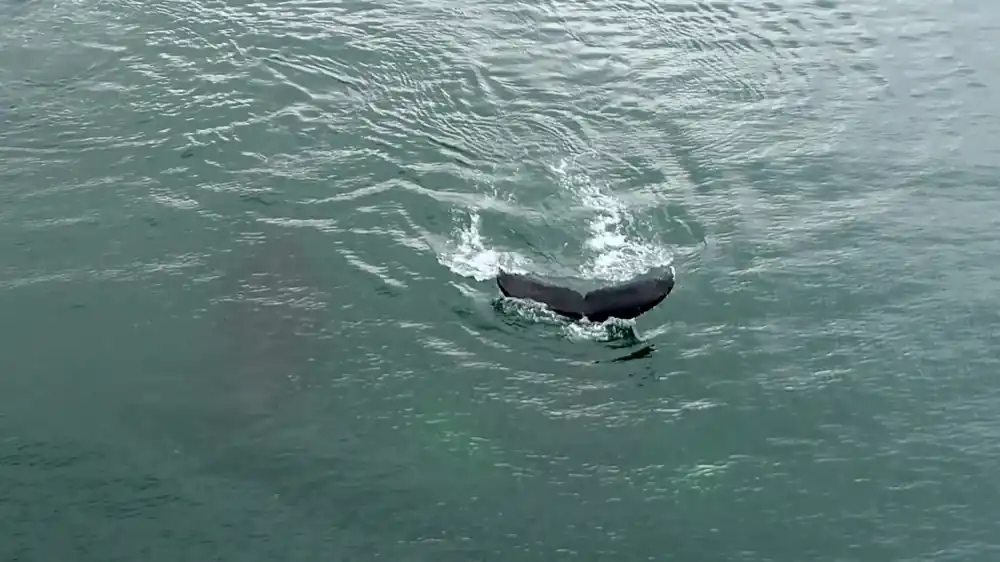
A disturbed whale stops feeding, gets separated from its calf or flees the bay. Costa Rica has regulated the activity since 2005, and SINAC imposes rules on operators. A good captain, in the field, is recognized by these behaviors:
- He cuts the engine and waits, instead of chasing the animal.
- He never encircles a group and never positions himself between a mother and her calf.
- He limits the approach time and lets other boats take over.
- He carries a naturalist guide, not just a pilot.
If the boat races towards every spout it spots, you're on the wrong vessel. We only work with certified operators, for the same reasons discussed in our article on responsible tourism in Costa Rica.
What else to see around Uvita
The Ballena coast deserves three nights, not a stopover. Within immediate reach:
- The Nauyaca waterfalls : 25 minutes from Uvita, entrance US$10, open Monday to Saturday from 7am to 2:30pm and Sunday from 8am to 2:30pm. Access via a 4 km trail or by 4×4.
- Dominical : a laid-back surf village, 20 minutes north — a good complement if you're interested in surfing in Costa Rica.
- The Térraba-Sierpe mangrove, further south, and access to the boats to Bahía Drake.
You can build and book this type of combination directly, day by day, on Toucan Dynamics, our online travel platform: you assemble flights, hotels and excursions directly, with the same providers we use for our tailor-made tours.
How to fit whales into your itinerary
Uvita fits naturally into a Pacific tour. Two patterns work particularly well:
- In 15 days : Arenal → Monteverde → Manuel Antonio → Uvita → back to San José. It's a variant of our 15-day Costa Rica itinerary.
- In 10 days : San José → Manuel Antonio → Uvita → Osa, concentrating everything on the southern Pacific. See our 10-day itinerary.
On the logistics side, a rental car comes to €70 per day, basic insurance included, and remains the most flexible solution on this coast. All the details in our guide on car rental in Costa Rica, and the full costing in our article Costa Rica travel budget. For the overall choice of period, refer to our pillar When to go to Costa Rica.
If you go further into Central America, note that Panama also offers beautiful sightings: see our article on whale watching in Panama.
Frequently Asked Questions
What is the best time to see whales in Costa Rica?
August and September, during the peak of the southern hemisphere migration. That's when individuals are most numerous and mothers with their calves are most visible near the coast.
Are you sure to see whales during a tour?
No serious operator guarantees a sighting: these are wild animals. In peak season in Uvita, success rates are however very high, and most providers offer a free second outing in case of a no-show.
Can you see whales from the beach?
Yes, it happens, especially from the heights of Uvita or the tip of the « whale tail » at low tide. But close observations and surface behaviors — breaches, fin slaps — are seen much better by boat.
Are the tours suitable for children?
Yes, generally from 5 or 6 years old, depending on the operator. The sea can be rough: choose a morning departure and a covered boat. For the little ones, see instead our tips for a trip to Costa Rica with a baby.
Want to time your trip to the whale season?
Tell us your dates and wishes: we build your tailor-made itinerary, with the right operators at the right time. Reply within 24 h.
Request a free quote · Build your trip directly on Toucan Dynamics
Plan your trip to Central America.
A Toucan Discovery advisor helps you transform these ideas into a tailor-made itinerary — Costa Rica, Panama, Nicaragua. Real-time availability, instant quote.
Plan my trip French
 English
 Spanish
 Italian
 German
 Chinese